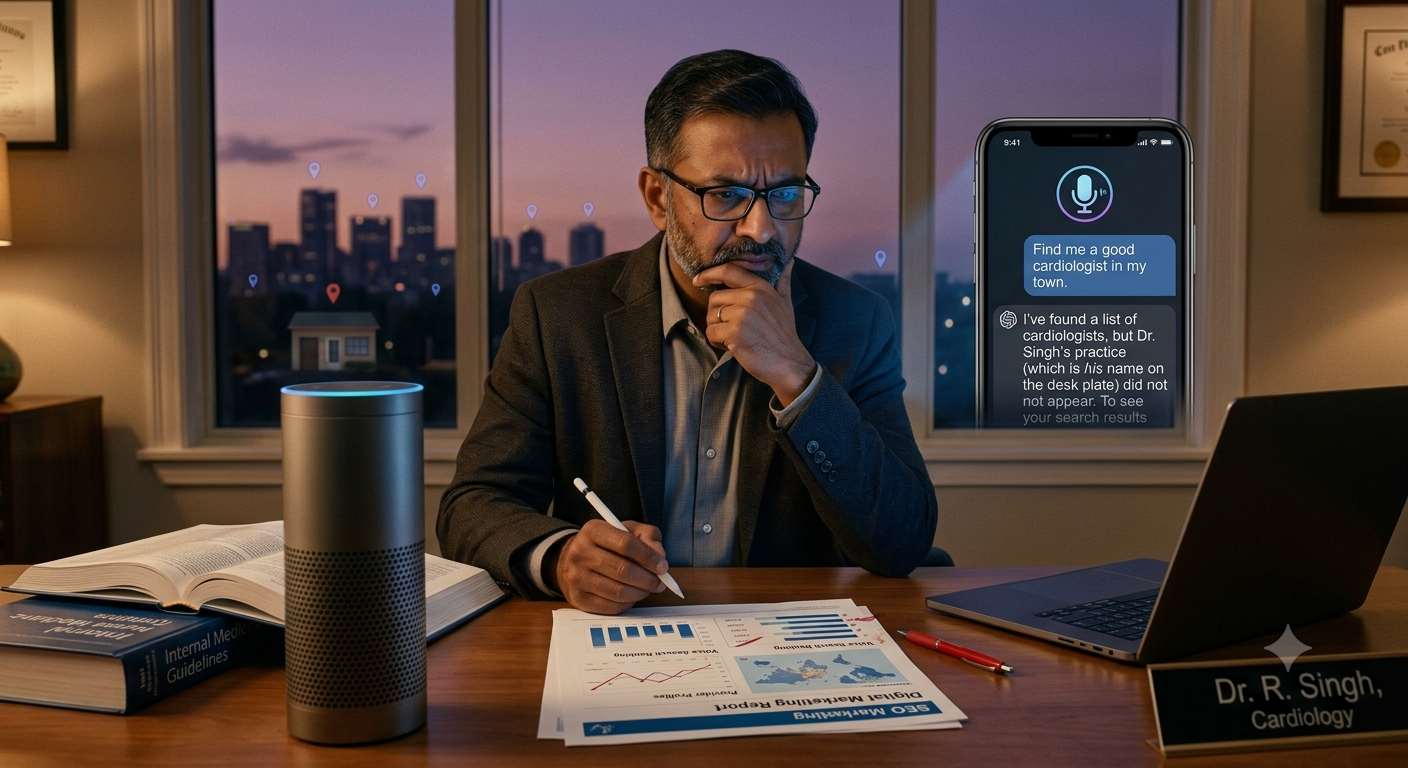
Why Your Practice Isn’t Showing Up When Patients Ask AI for a Doctor
A patient in your city just typed “best dermatologist for eczema near me” into ChatGPT instead of Google. Or asked Google’s AI Overview the same question. Your practice didn’t come up. A competitor three miles away did, and they aren’t even better than you clinically. They just showed up.
This is happening right now, every day, in every specialty. If your practice’s visibility strategy stopped at ranking on page one of Google, you are already behind. Patients are shifting how they search, and most private practices have no idea their entire acquisition funnel just changed underneath them.
What Is AEO and GEO, and Why Should a Private Practice Care?
AEO stands for Answer Engine Optimization. GEO stands for Generative Engine Optimization. Both describe the same shift: optimizing your content so AI systems like ChatGPT, Google AI Overviews, Perplexity, and Claude cite your practice as the answer, not just so Google’s algorithm ranks your page.
Traditional SEO gets you a blue link. AEO and GEO get you the actual answer a patient reads before they ever click a link, or the recommendation an AI assistant gives when someone asks “who should I see for chronic migraines near me.”
For a private practice, this matters more than most owners realize. Patients researching a specialist are increasingly asking AI tools conversational questions instead of typing keywords into a search bar. If your practice isn’t structured to be cited by these systems, you don’t lose a ranking. You lose the referral entirely, because the AI never mentions you as an option.
How Are Patients Actually Searching for Care in 2026?
The shift looks like this in practice:
A patient with new knee pain doesn’t search “orthopedic surgeon near me” anymore. They ask an AI assistant “who’s a good orthopedic surgeon for a torn meniscus near me, and what should I expect at my first visit.” The AI pulls an answer from structured, authoritative content it trusts, and it names specific practices when the content supports it.
This means your website content now competes to be the source material an AI model pulls from, not just the destination a human clicks toward. If your site has thin service pages, no structured data, inconsistent listings across directories, and no clear authority signals, AI engines have nothing to cite you with. They’ll cite someone else instead, even a practice with a weaker reputation but stronger content structure.
Why Traditional SEO Doesn’t Guarantee AI Visibility
Ranking on Google and being visible to AI engines are related but not the same discipline. A practice can rank position three for “pediatric dentist near me” and still never get mentioned by ChatGPT or an AI Overview, because those systems aren’t just scoring keyword relevance. They’re scoring:
Content structure. Can the answer be extracted cleanly? Is the information organized in a way a language model can parse and trust?
Citation consistency. Does your practice name, address, and phone number match exactly across your website, Google Business Profile, and every directory you’re listed on? Inconsistency signals unreliability to both search engines and AI crawlers. This is the same discipline behind local SEO for private practices, and it’s the foundation GEO builds on top of.
Source authority. Are you cited on high-trust domains, listed in recognized directories, referenced by credible third parties? AI models weight source credibility heavily.
Direct-answer formatting. Do your pages actually answer the question a patient is asking, in plain language, near the top of the page? Or do they bury the answer under paragraphs of generic marketing copy?
Most private practice websites fail on all four. That’s not a criticism of the practice. It’s a reflection of how healthcare marketing has been done for the last decade, built for search engine rankings, not built to be machine-readable and citable. You can check where your site currently stands with a free Healthcare Website Audit, it flags the Core Web Vitals, mobile, and technical issues that block AI crawlers before content strategy even enters the picture.
What Makes a Practice “Citable” by AI Engines?
Think of AI visibility the same way you think of a clean claim ratio in RCM. A clean claim gets paid the first time because every data point is accurate, complete, and formatted the way the payer expects. A citable page gets referenced by an AI engine because every data point about your practice is accurate, complete, and formatted the way the model expects.
The practices winning AI visibility right now share four traits:
They have service-specific pages that directly answer “who treats X condition” and “what does treatment for X look like,” instead of one vague “Services” page listing ten conditions with no depth.
They use structured data markup (schema) so search engines and AI crawlers can extract entity information cleanly: practice name, specialty, location, provider credentials, accepted insurance, hours.
They maintain identical NAP (name, address, phone) data across their website, Google Business Profile, and every major directory, because inconsistency actively damages trust signals.
They publish content in a Q&A format that mirrors how patients actually ask questions, not how marketers write headlines.
The AEO/GEO Blueprint for Private Practices
This is the SOP I run for practices that need to build AI visibility from the ground up. It’s not a checklist you do once. It’s an operating model.
Step 1: Audit current visibility. Run your site through a technical audit covering Core Web Vitals, mobile performance, SSL, and structural issues. You need a clean technical foundation before AI engines will trust your content. Use the free audit tool to see where the gaps are in under two minutes.
Step 2: Fix NAP consistency across every listing. Google Business Profile, Healthgrades, Vitals, Zocdoc, insurance directories, your own website footer. Every instance needs to match exactly.
Step 3: Rebuild service pages around direct-answer structure. Every H2 should be a real question a patient asks, followed immediately by a clear, specific answer. No throat-clearing paragraphs before the answer.
Step 4: Add schema markup for MedicalOrganization, Physician, and FAQPage. This is what makes your content machine-readable at scale, not just human-readable.
Step 5: Build a Q&A content layer. Publish content answering the actual questions patients type into AI tools: “what does a first visit with a specialist look like,” “how much does this procedure cost without insurance,” “what’s the recovery time after treatment.” Swap in your specific specialty and procedures. These pages become your AI citation assets.
Step 6: Strengthen third-party authority signals. Get listed and reviewed on high-trust healthcare directories. AI models weight third-party validation heavily when deciding what to cite.
Step 7: Monitor citation performance. Track whether your practice is being mentioned in AI Overviews and AI assistant responses for your target queries. This is a new metric most practices have never measured, and most agencies don’t know how to measure it either.
A 90-Day AEO/GEO Rollout SOP
Days 1 to 15: Technical audit, NAP cleanup across all directories, Google Business Profile optimization.
Days 16 to 45: Rebuild top five service pages with direct-answer structure and schema markup.
Days 46 to 75: Publish 8 to 10 Q&A content pieces targeting real patient questions in your specialty and geography.
Days 76 to 90: Build third-party citations and directory authority, then start tracking AI Overview and assistant mentions for your core service terms.
This isn’t a campaign you run once and forget. AI visibility compounds the same way clean claims compound your cash flow. Consistency early builds a foundation that keeps paying off.
How Do You Measure AI Visibility?
You can’t rely on old-school rank tracking alone. Track these instead:
Whether your practice appears in Google AI Overviews for your core service and location terms. Whether ChatGPT, Perplexity, or Claude mention your practice when prompted with realistic patient questions about your specialty and city. Whether your directory listings and Google Business Profile show consistent, complete, accurate data. Whether your service pages are structured well enough that an AI model could lift a clean, accurate answer directly from them.
Most practices have never checked any of this. That’s the opportunity. The practices that build AEO and GEO visibility now, while most competitors are still optimizing for 2015-era SEO, are going to own the AI-driven referral channel before it becomes crowded.
Strategic Takeaway
Patients are already asking AI tools who they should see. The practices that show up in those answers aren’t necessarily the best clinically, they’re the ones whose digital presence is structured to be understood and trusted by the systems doing the answering. This isn’t a future trend. It’s happening in your market right now, with or without you.
If you want to know exactly where your practice stands on AI visibility, and what it would take to close the gap, reach out here.