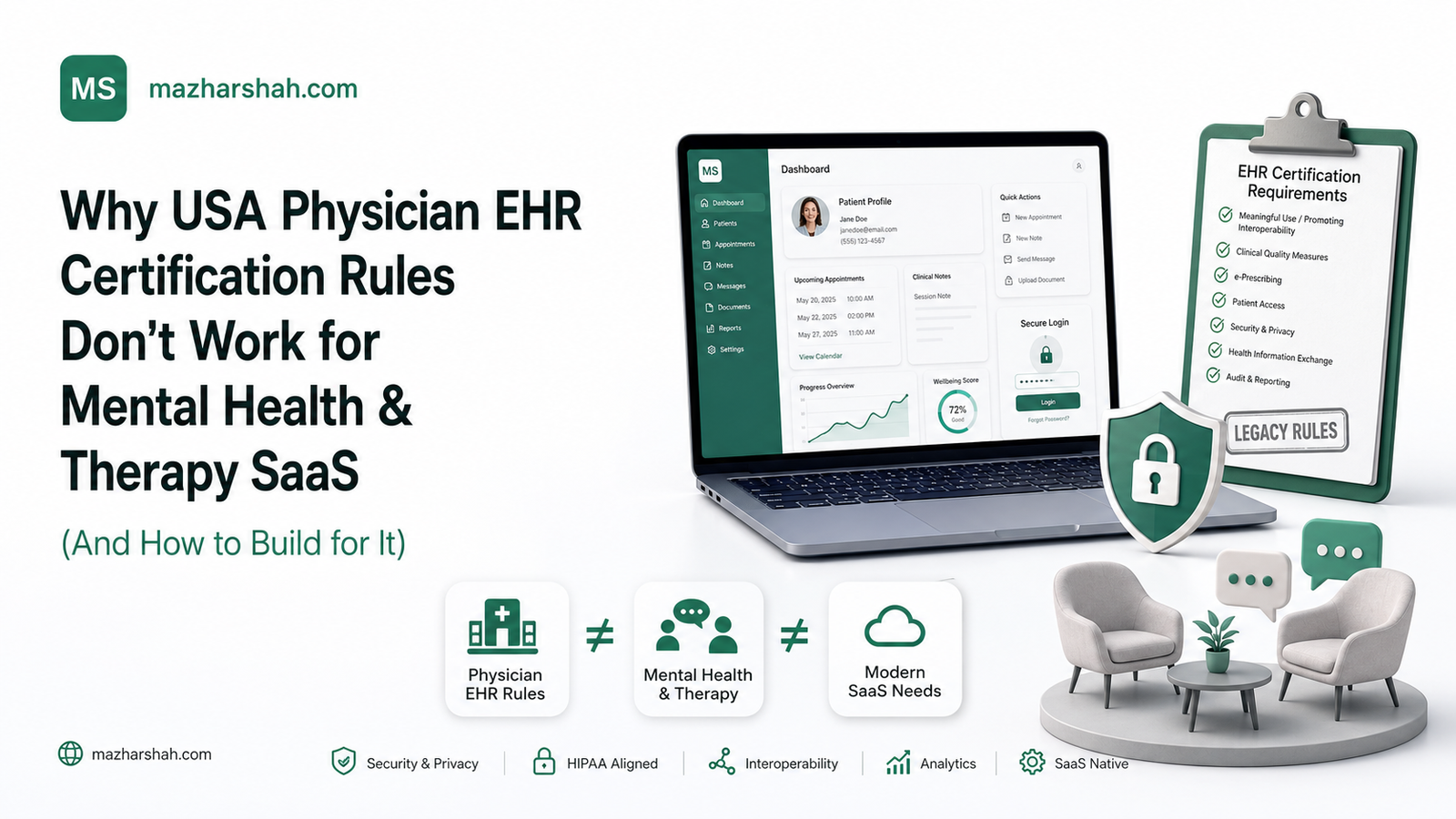
Why USA Physician EHR Certification Rules Don’t Work for Mental Health & Therapy SaaS
If you’re building EHR or practice management software for therapists, counselors, or psychologists, and you’re staring down ONC certification requirements built for cardiologists, stop. That certification path is solving a problem you don’t have.
I’ve spent 15+ years in USA healthcare growth and billing consulting, working with EHR vendors, RCM companies, and clinics across physical medicine and behavioral health. The pattern is consistent: founders entering the mental health SaaS space assume they need the same federal certification stack as a primary care EHR. They don’t. Understanding why will save you six figures and months of engineering time.
The Physician CEHRT Mandate, Briefly
Traditional USA physicians operate under a federal compliance stack built through HITECH, ONC, and CMS:
- CEHRT (Certified EHR Technology) is required to participate in MIPS/MACRA under the CMS Quality Payment Program
- Failing to use certified technology triggers downward payment adjustments from Medicare, detailed directly in CMS’s Promoting Interoperability CEHRT attestation guidance
- Certification itself runs through ONC’s Health IT Certification Program, covering things like e-prescribing (including controlled substances), lab result interfaces, ICD-10 coded problem lists, and structured vitals data
- The entire framework assumes a physical medicine encounter: a diagnosis code, an order, a lab value, a prescription
This isn’t a minor administrative box to check. Full ONC 2015 Edition certification is an expensive, multi-month process involving accredited testing bodies, security risk assessments, and ongoing maintenance obligations tied to every product update.
Behavioral Health Was Never Built Into This System
Here’s the part most SaaS founders miss: licensed psychologists, LMFTs, LCSWs, and counselors were historically excluded from the federal EHR incentive programs that created the CEHRT mandate in the first place.
When HITECH rolled out EHR incentive funding in 2009, behavioral health providers were specifically left out. Congressional efforts to close that gap, including the Behavioral Health Information Technology Act and the earlier Health Information Technology Extension for Behavioral Health Services Act, repeatedly tried to extend Medicare and Medicaid EHR incentives to psychologists, clinical social workers, and psychiatric hospitals. Much of that legislative effort never fully closed the gap.
The practical result: most solo and group therapy practices never had a Medicare payment penalty tied to using certified technology, because they were never inside the MIPS eligible clinician framework in the same way physicians are. No CEHRT mandate, no penalty exposure, no regulatory reason to chase full ONC certification.
If your target customer is a licensed therapist running private-pay or insurance-based outpatient therapy, they are very likely not the clinician type this certification stack was designed to police.
Why Certified EHR Architecture Actively Fights Behavioral Health Workflows
This isn’t just “they don’t need it.” Forcing a CEHRT-style architecture onto a therapy SaaS product creates real product friction. Here’s where the mismatch shows up in the data model:
Clinical documentation
- Physical medicine EHRs are structured around ICD-10 diagnosis codes, vitals, and lab result integrations
- Therapy documentation centers on psychotherapy notes, which under HIPAA get a separate, heightened privacy category defined explicitly at 45 CFR § 164.501 and reinforced by the authorization requirements in 45 CFR § 164.508. They require distinct consent and access controls, not a standard progress-note field
Prescribing
- E-prescribing of controlled substances (EPCS) is a core certified-EHR function under ONC’s certification criteria
- Most therapy-only providers don’t prescribe at all. Building EPCS infrastructure for a customer base that doesn’t need it is pure sunk cost
Scheduling
- Physical medicine scheduling is largely 1:1, procedure-based
- Behavioral health needs group therapy scheduling, recurring weekly session cadences, and no-show/late-cancellation billing logic that generic EHR scheduling modules don’t handle well
Outcomes
- Certified EHRs track structured clinical metrics: labs, vitals, med lists
- Therapy outcome tracking uses standardized instruments (PHQ-9, GAD-7, etc.) trended over time per client, which is a fundamentally different data shape than a vitals flowsheet
Building toward ONC certification pulls your engineering roadmap toward interoperability standards your actual buyer will never ask about, while starving the workflows they’ll cancel their subscription over if you get wrong.
Where You Should Actually Invest Instead
If you’re building for the mental health and therapy niche, redirect the budget and engineering hours you’d spend on full ONC certification toward this stack:
1. HIPAA compliance, done properly
- Business Associate Agreements with every subprocessor (hosting, email, payment, fax/e-fax), per HHS guidance on Business Associates
- Encryption at rest and in transit, non-negotiable
- Role-based access controls with separate permission tiers for psychotherapy notes specifically, consistent with the HHS summary of the HIPAA Privacy Rule, not just general PHI
- Signed audit logging on every chart access, not just edits
2. Specialized billing workflows
- Superbill generation for out-of-network reimbursement, since a huge share of therapy is private-pay or out-of-network
- Recurring private-pay billing, card-on-file with automated retry logic for weekly or biweekly sessions
- CPT codes specific to psychotherapy (90837, 90847 for family therapy, 90853 for group) rather than a generic E/M code library
- Sliding scale and package/bundle billing support, common in private-pay therapy practices and largely absent from physician-oriented EHR billing modules
3. Teletherapy-first architecture
- HIPAA-compliant video, not consumer-grade video conferencing bolted on
- Session documentation that ties directly to the video encounter for audit purposes
- State licensure and telehealth compliance logic, since a therapist licensed in one state generally can’t treat a client physically located in another without additional authority. CMS’s telehealth policy page is a useful starting reference for how federal rules intersect with state licensure
4. Group and recurring scheduling logic
- Support for recurring weekly client slots as a first-class scheduling primitive, not an edge case
- Group session capacity management with per-client billing inside a shared session
None of this requires ONC certification. All of it requires you to actually understand behavioral health operations, which most generic EHR templates don’t.
The Market Positioning Angle
There’s a growth argument here too, not just a technical one. Every physician-focused EHR vendor is fighting for a market where CEHRT compliance is table stakes and differentiation happens on price and integrations. That’s a crowded, capital-intensive fight.
Mental health and therapy SaaS is a market where:
- The compliance floor is different (HIPAA, not HIPAA-plus-CEHRT)
- The buyer cares more about billing friction and clinical note quality for their specific modality than about e-prescribing or lab interfaces
- Incumbent players who built physician-grade certified platforms are often clunky and over-engineered for a therapist’s actual workflow
If you build specifically for this niche instead of trying to be “EHR software that also works for therapists,” you win on fit, not just feature count.
Key Takeaway for Tech Founders and Product Leaders
- Don’t chase ONC/CEHRT certification by default. Confirm your actual target clinician type is even inside the MIPS eligible clinician framework before you spend six figures on certification testing.
- Behavioral health has a different legal and workflow profile than physical medicine. Psychotherapy notes carry extra HIPAA protection under 45 CFR § 164.501. Design your permission model around that from day one, not as a retrofit.
- Spend your engineering budget on the things your buyer actually pays for: superbills, recurring private-pay billing, group scheduling, teletherapy-native architecture.
- Verify state-by-state telehealth and licensure rules if you’re building teletherapy features. This is a compliance surface that’s separate from, and often more relevant than, federal EHR certification for this buyer.
- Position the product on fit, not certification badges. A therapist choosing software cares about session notes, billing friction, and client scheduling, not whether you’re 2015 Edition certified.
Build for the clinician in front of you, not the certification checklist built for someone else’s specialty.
If you’re a founder or product lead trying to figure out the right compliance and growth strategy for a behavioral health or therapy SaaS product, this is exactly the kind of positioning work I help clients with. Get in touch if you want a second opinion before you commit engineering budget.