How AI Search Engines Choose Which Healthcare Practices to Recommend
Sarah had been putting off her knee surgery for months. One evening, instead of scrolling through Google results, she opened ChatGPT and typed something simple: “Which orthopedic surgeons in Austin have the best track record with knee replacements?”
In seconds, she had three names. She booked a consultation with the first one the next morning.
She never opened Google. She never scrolled past a single ad. She never compared five tabs of search results the way patients used to. The AI did that work for her, and it handed her a short, confident answer.
Somewhere in Austin, a highly-rated orthopedic practice with excellent outcomes and a beautiful website never entered the conversation. Not because it wasn’t good. Because the AI didn’t know enough about it to recommend it with confidence.
This is happening every day now, in exam rooms and living rooms and car rides, as patients quietly shift from searching to asking. And it’s rewriting the rules of how healthcare practices get found.
The Patient Isn’t Comparing Anymore. The AI Is.
For twenty years, healthcare marketing has run on a simple idea: rank higher, get seen. Build a fast website, write good content, earn some backlinks, climb the search results, and patients would find you among the list of options.
That world hasn’t disappeared, but a second world has grown up alongside it. In this new world, the patient doesn’t see a list at all. They see an answer. ChatGPT, Gemini, and Perplexity read the landscape of information about your practice and hand the patient two or three names, sometimes with a sentence explaining why.
If your practice isn’t one of those names, it’s as if you don’t exist. There’s no page two to eventually get discovered on. There’s just silence.
This is the difference between being findable and being recommendable. And healthcare, more than almost any other industry, runs on recommendation. Patients have always trusted a name that comes with a “you should see them” attached to it. AI has simply become the one doing the recommending.
Why a Great Website Isn’t Always Enough
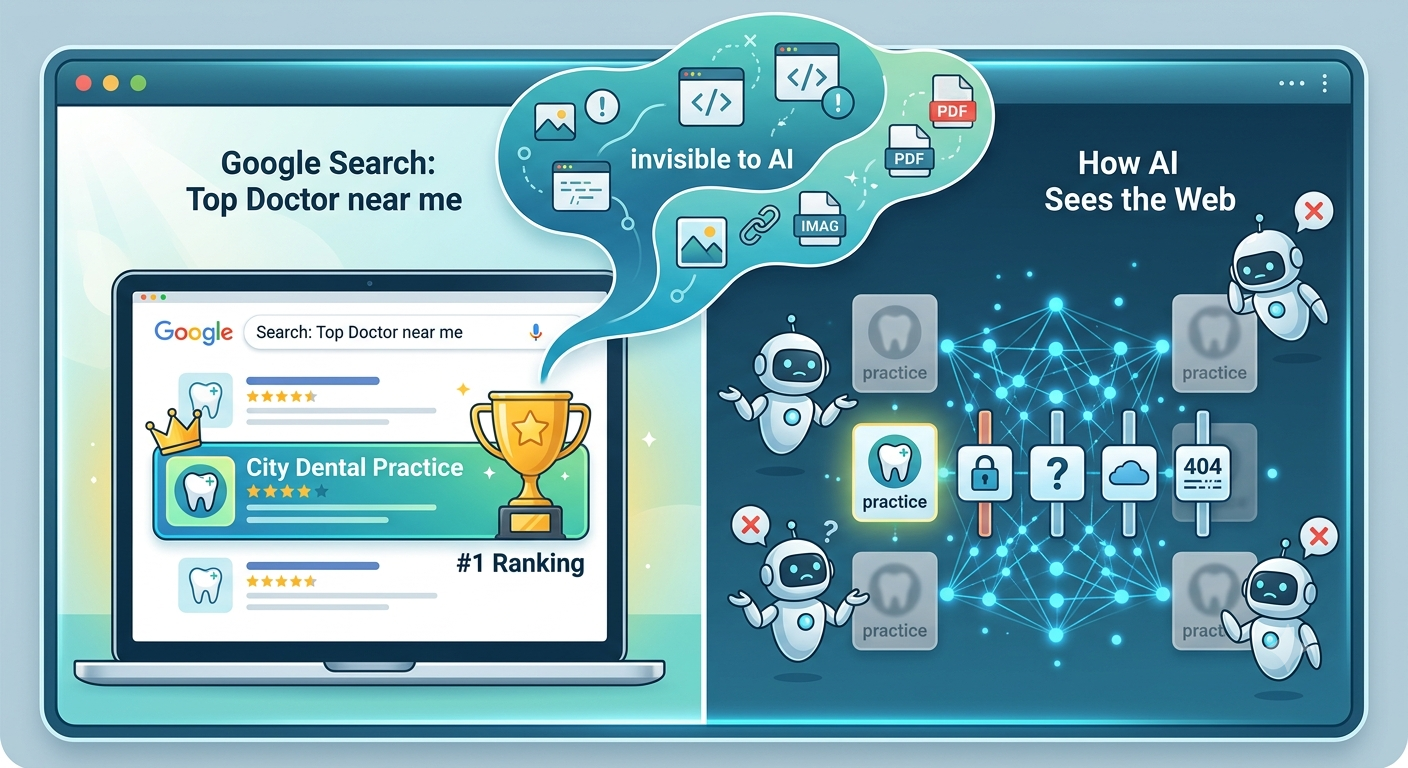
Here’s what surprises most practice owners: ranking well on Google doesn’t guarantee anything in AI search. The two systems work on completely different logic.
Search engines look at your page. AI systems try to understand your practice as a whole, the way a well-connected patient coordinator would. Who are you? What do you treat? Where do you practice? What do other people say about you? Is your information consistent everywhere it appears, or does it contradict itself across ten different directories?
Think about it from the AI’s perspective. If it’s going to put your name in front of a patient making a real healthcare decision, it needs to be confident. That confidence doesn’t come from one optimized landing page. It comes from your name showing up, again and again, in places the AI has learned to trust: patient review platforms, local health directories, news mentions, other credible sites that talk about your specialty and mention you by name.
A smaller practice with a clear, consistent, well-documented presence across the web can out-recommend a larger practice with a messier digital footprint, even if the larger practice technically outranks it on Google. That’s a hard thing for a lot of practice owners to hear, but it’s the reality of how these systems work.
The Four Things AI Actually Looks For
How often your name shows up in the right context. Not spammy repetition, genuine presence. If your practice keeps appearing alongside the conditions you treat, in the places patients and other providers already look, the AI builds a stronger connection between your name and that specialty.
Whether your practice reads as a clear, real entity. Your name, address, and phone number need to match everywhere, your website to your Google Business Profile to every directory you’re listed in. Outdated addresses and inconsistent details quietly tell AI systems your information can’t be fully trusted.
Whether you match the specific question being asked. A general family practice won’t automatically surface when someone asks about a specific condition, unless there’s real content and real mentions connecting that practice to that condition specifically. Broad positioning gets broad, forgettable results. Specific positioning gets remembered.
Whether anyone besides you is vouching for you. Your own website saying you’re excellent only goes so far. Reviews on Google and Healthgrades, mentions in local news, inclusion in “best of” lists from independent sources, these carry weight your own copy never will.
What This Actually Means for Your Marketing
None of this replaces good SEO. It builds on it. Technical SEO, quality content, and a fast, well-structured website are still the foundation everything else sits on.
What’s changed is the goal. You’re no longer just trying to rank. You’re trying to become the kind of practice an AI system can describe with confidence, because the same story is being told about you everywhere it looks.
A few places to start:
- Check your NAP everywhere. Your name, address, and phone number should match exactly across your website, Google Business Profile, insurance panels, and every directory you appear in. Small inconsistencies add up to real doubt in an AI’s confidence.
- Write about the specific conditions you treat, not just your general specialty. Real detail, real experience, real answers to the questions patients actually ask, not definitions they could find anywhere.
- Go after mentions you don’t control. A feature in a local health publication or a strong review on a trusted platform does more for your AI visibility than another page on your own site.
- Clean up what’s outdated. Old addresses, retired providers still listed, abandoned directory profiles, all of it works against you.
- Make your content easy to lift. Clear headings, direct answers, real questions patients ask answered plainly. The easier it is for an AI to understand what you offer, the easier it is to recommend you.
The Practices That Will Win This Decade
Sarah’s story isn’t rare anymore, it’s becoming the norm. Patients are asking AI the questions they used to type into Google, and the practices that show up in those answers won’t necessarily be the ones with the flashiest websites or the biggest ad budgets.
They’ll be the ones whose story is told the same way everywhere it’s told. Consistent. Documented. Vouched for by people who aren’t on the payroll.
That’s not a trend to watch from a distance. It’s already deciding who gets the next Sarah, and who never gets the chance.
Frequently Asked Questions
Does ranking #1 on Google guarantee AI will recommend my practice? No. Search rankings and AI recommendations run on different logic. Search engines evaluate individual pages. AI systems evaluate your practice as a whole entity, based on consistency and third-party validation across the web.
What’s the single biggest factor in AI healthcare recommendations? Consistency. Your practice name, address, phone number, and description need to match everywhere they appear online. Inconsistent information reduces an AI system’s confidence in recommending you.
Do patient reviews actually affect AI search visibility? Yes. Reviews on platforms like Google and Healthgrades act as third-party validation, which carries more weight with AI systems than content on your own website alone.
How is this different from traditional SEO? Traditional SEO still matters and remains the foundation. AI visibility (sometimes called GEO, or generative engine optimization) extends that foundation by focusing on how your practice is understood as a complete entity across the entire web, not just how one page ranks. Build a Healthcare FAQ Page That Wins AI Citations