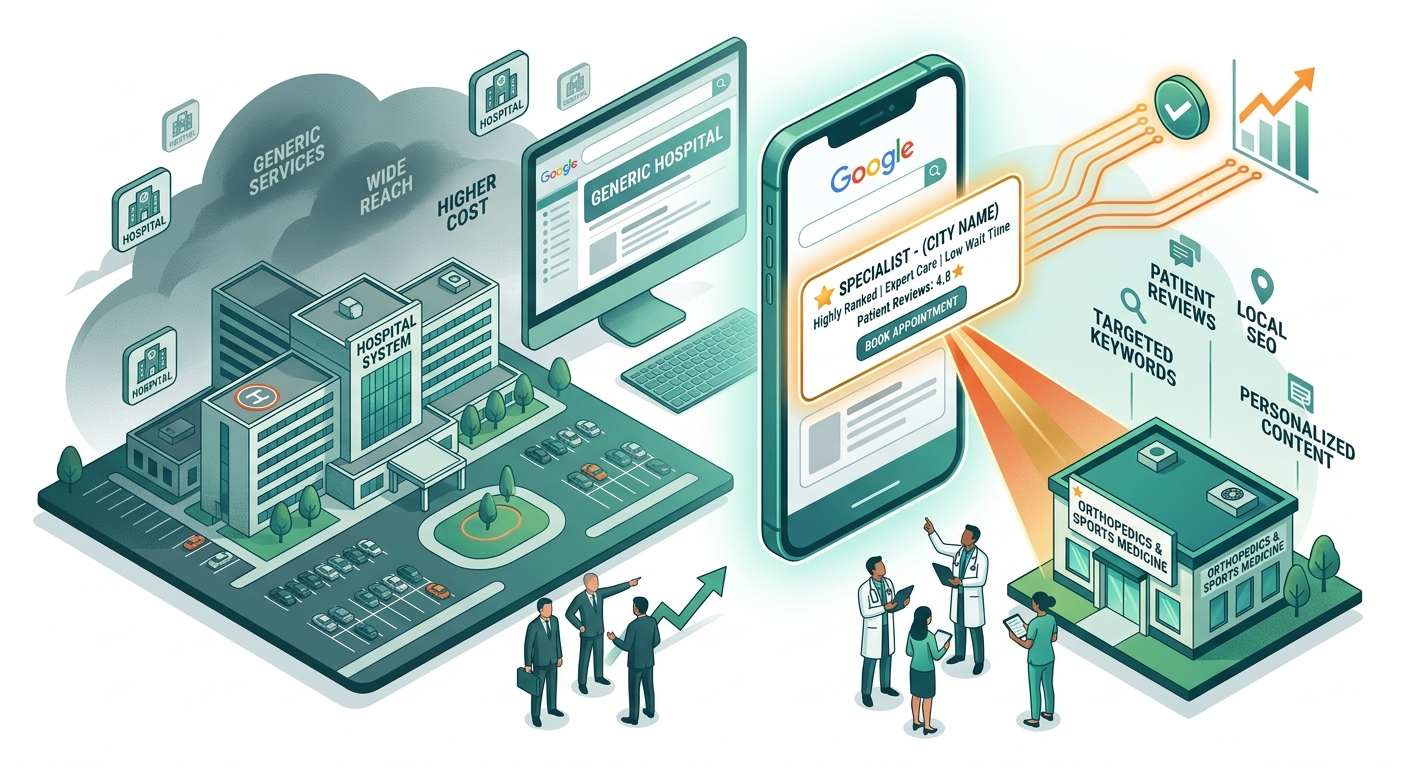
How Specialty Practices Can Compete With Hospital Systems on Google
Let me say something that most SEO agencies will not tell you.
You are never going to out-rank Johns Hopkins for “cardiology services.” You are not supposed to. That is not the game you should be playing.
The practices that win on Google are the ones that stop trying to beat hospital systems at their own game and start playing a completely different one. One where the rules actually favor the independent specialist.
Here is how that works.
The Hospital System SEO Advantage Is Real but Narrow
Hospital systems have domain authority built over decades. They have content teams, PR departments, and thousands of inbound links from news coverage and academic citations. On broad generic searches, they dominate. Nobody is arguing that.
But broad generic searches are not where patients with real intent are searching.
A patient newly diagnosed with atrial fibrillation is not searching “cardiology near me.” They are searching “electrophysiologist who takes Aetna in Dallas” or “best EP doctor for AFib without surgery.” A parent managing a child with Type 1 diabetes is not searching “endocrinology services.” They are searching “pediatric endocrinologist experienced with insulin pump management in Phoenix.”
These searches are long, specific, and loaded with buying intent. Hospital systems rarely optimize for them because their content strategy is built around volume and brand. Your strategy can be built around precision. That is your edge.
Hyperlocal SEO Is the Specialist’s Strongest Weapon
Google wants to serve the most relevant result, not just the most authoritative one. Relevance is something a specialty practice can own.
Start with your Google Business Profile. Most specialist practices have a GBP that is incomplete, unoptimized, and never updated. Hospital systems have the opposite problem. Their GBP listings are often generic because they cover dozens of departments under one umbrella.
Your GBP should be built around your specific specialty, your specific conditions treated, your specific insurance panels, and your specific location. Every service you list, every post you publish, every review you earn signals to Google exactly who you are and who you serve.
Add your top three to five conditions treated directly in your GBP description. Update it with a post every two weeks. Make sure your NAP (name, address, phone) is identical across every directory. These are basic moves that consistently beat hospital system listings at the local level because hospital systems simply do not execute at this level of specificity.
Your Website Needs Condition Specific Pages Not Just a Services Page
This is where most specialty practices leave the most visibility on the table.
A single “Services” page listing every condition you treat is invisible to Google. It gives the algorithm nothing specific to rank. It gives patients nothing specific to trust.
What works is a dedicated page for each major condition or procedure you want to attract patients for. Each page should answer the questions a newly diagnosed or concerned patient is actually typing into Google. What is this condition. What causes it. What are the treatment options. What should I expect at my first appointment. Why see a specialist instead of a primary care physician.
Write these pages the way you would explain the condition to a patient sitting in your exam room. Not like a medical journal. Not like a hospital system brochure. Like a doctor who has treated this condition a thousand times and knows exactly what the patient is afraid of.
Google rewards depth and specificity. Patients reward clarity and trust. A well written condition page does both.
Reviews Are Now a Ranking Signal and a Conversion Tool
Hospital systems collect reviews at scale but rarely manage them well. Individual specialty practices that actively manage their review presence consistently outperform larger competitors in local search results.
After every positive patient interaction, make asking for a Google review a standard part of your checkout or follow-up process. A simple text message or email with a direct link to your GBP review page converts well. You do not need a hundred reviews a month. You need a steady stream of recent, specific, authentic reviews that mention your specialty, your conditions treated, and your location.
“Dr. Shah was the only electrophysiologist in Scottsdale who took the time to explain my AFib options clearly” is worth more to your local rankings than ten generic five star reviews.
GEO Is the New Layer Every Specialist Needs to Understand
Here is something that most practices and most agencies have not caught up with yet.
Google is no longer the only place patients discover providers. AI tools like ChatGPT, Perplexity, and Google’s own AI Overviews are now surfacing provider recommendations based on content signals, not just traditional SEO rankings.
This is called Generative Engine Optimization and it changes how you need to think about your content.
To show up in AI-generated answers, your website needs to be structured as a clear, authoritative source of information about your specialty. That means schema markup that tells search engines exactly what type of provider you are, what conditions you treat, and where you practice. It means FAQ content that directly answers the questions AI tools pull from. It means building topical authority around your specialty so that when an AI model is deciding which cardiologist to recommend in your city, your name has enough signal behind it to surface.
Most hospital systems are not thinking about GEO yet at the individual specialty level. This is another window that is open right now for the independent specialist who moves first.
The Content Moat Strategy for Long Term Dominance
The practices that will own their local search results three years from now are the ones building content depth today.
Pick your top five conditions. Write the definitive patient resource page for each one. Add a blog section where you publish answers to the questions your patients ask you every week. Record short educational videos and embed them on your site. Build internal links between your condition pages, your provider bio, and your contact page.
This is not about going viral. It is about becoming the most thorough, most trusted, most relevant source of information for your specialty in your city. When you do that, Google has no choice but to rank you. And when AI tools are looking for a credible specialist to recommend, your digital footprint gives them every reason to choose you.
What This Looks Like in Practice
I worked with a specialty practice competing against two major hospital systems in their metro area. They had a decent website, a thin GBP listing, and no condition specific content.
Within eight months of building out dedicated condition pages, optimizing their GBP, and launching a consistent review acquisition process, they were outranking both hospital systems for six of their highest-value patient search terms. Not on every keyword. Not on broad terms. On the specific, high-intent searches that were bringing in new patients ready to book.
That is the game. Narrow, specific, and deeply relevant always beats broad and generic in local healthcare search.
The Window Is Still Open
Most specialty practices are still playing the old game. Thin websites. Generic content. Ignored GBP listings. No GEO strategy.
The practices that invest in a precise, specialty-specific digital presence right now will build a search advantage that compounds over time and becomes genuinely difficult for competitors, including hospital systems, to displace.
You do not need to be everywhere. You need to be the most relevant result for the patients who are already looking for exactly what you do.
That is a winnable position. And it starts with treating your digital presence like the growth asset it actually is.
If you want to know exactly where your practice stands in search and what is costing you new patients, I do a free website audit at mazharshah.com.