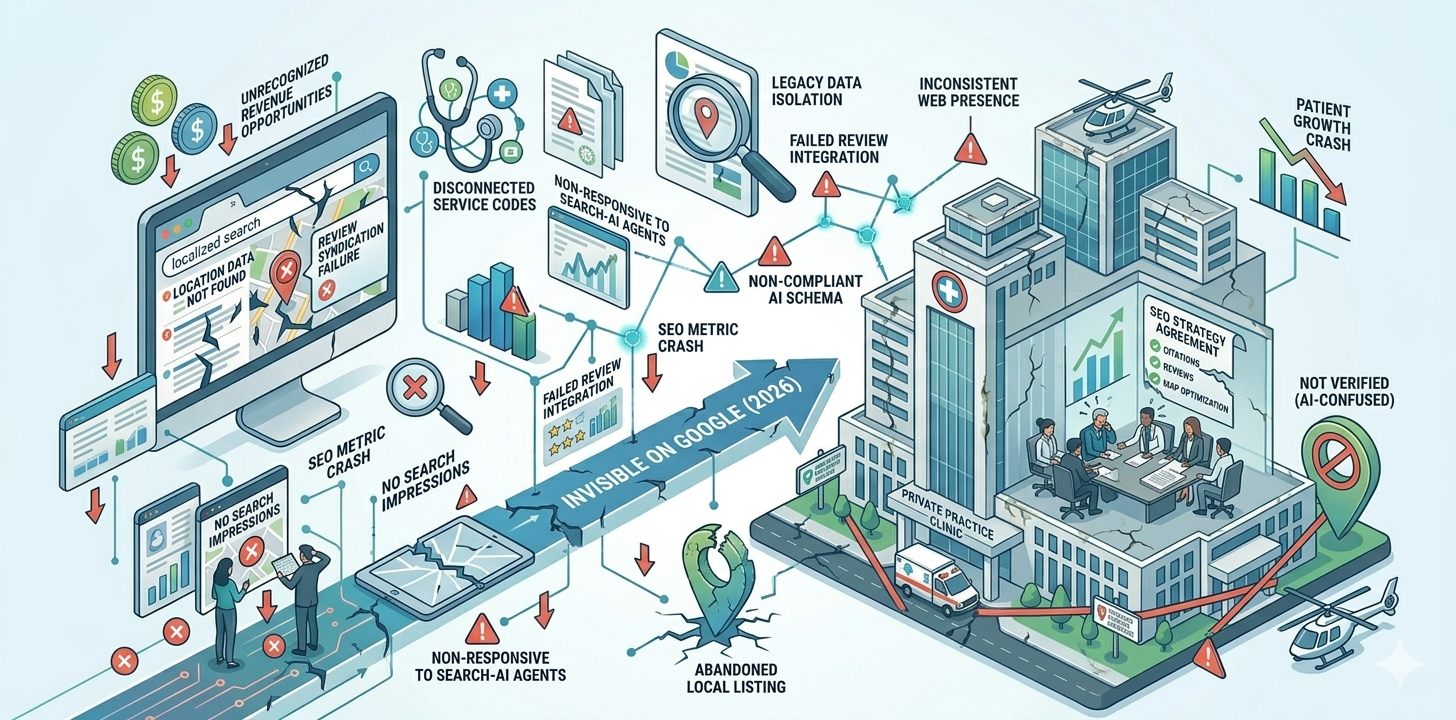
The Real Reason Your Medical Practice Is Invisible on Google in 2026
Your website has about 7 seconds to convince a patient to stay. Most healthcare websites fail that test not because they look bad, but because they say nothing meaningful.
Being invisible on Google is no longer just a marketing problem for healthcare practices. It is a revenue problem. And in 2026, the way patients find doctors has changed enough that strategies from even two years ago are producing half the results.
Here is what is actually happening and what you can do about it.
AI is now the first stop, not Google Search
A growing percentage of patients are now typing their symptoms and questions directly into AI tools like ChatGPT, Google’s AI Overview, and Perplexity before they ever click a single search result. If your practice is not being recommended by these AI systems, you are missing an entire layer of patient discovery that did not exist two years ago.
Getting recommended by AI is not about gaming a system. It is about having enough credible, consistent, well-structured content online that AI tools recognize you as an authoritative source in your specialty and geography.
Google still matters, but the rules changed
Traditional SEO told you to stuff your pages with keywords. That approach is now actively hurting practices. Google’s current algorithm rewards expertise, trust signals, and content that genuinely answers patient questions.
For a medical practice, trust signals include verified Google Business Profile information, consistent NAP data across all directories, physician bios with credentials, patient reviews that mention specific conditions and treatments, and schema markup that tells Google exactly what your practice does and where.
If even two or three of these are missing or inconsistent, your rankings suffer.
The local visibility gap
Most practices I work with have a local visibility gap. They rank reasonably well for their own name but almost not at all for the condition-based searches that new patients actually use. Nobody Googles “Dr. Smith dermatology.” They Google “best dermatologist for acne near me” or “skin rash treatment Dallas.”
Closing that gap requires a content strategy built around patient questions, not just service names.
What to prioritize right now
First, claim and fully optimize your Google Business Profile if you have not already. This is still the single highest-ROI action for local healthcare visibility.
Second, create at least one piece of content per month that answers a specific patient question related to your specialty. It does not need to be long. It needs to be accurate, clear, and genuinely useful.
Third, audit your directory listings. Your name, address, and phone number should be identical across Google, Healthgrades, Zocdoc, Yelp, and any other platform where your practice appears. Inconsistencies confuse both Google and patients.
Visibility is not luck. It is the result of consistent, strategic effort applied in the right places.